
November 2025 CFCPRP Convening Highlights
May 7, 2026
The California Firefighter Cancer Prevention and Research Program (CFCPRP) convened its Advisory Committee and grantees on November 10, 2025, bringing together 45 attendees remotely for the first official gathering of grantees, advisory committee members, and program leadership and staff. Through a series of research project presentations and small group discussions, the meeting showcased the impactful portfolio of community-partnered firefighter cancer research across the state of California.
Grantee Research Presentations
Each of the eight funded research teams, which are co-led by California firefighters and University of California (UC) researchers, was represented by both Co-Principal Investigators, who presented initial results and discussed ongoing research activities. Research teams presented early findings across the program’s focus areas, including perceived susceptibility and other social factors, reducing cancer risk and occupational exposures, and DNA mutations and chemical exposures.
Perceived susceptibility
Co-Principal Investigators Andrew Violante, fire captain and paramedic with the San Marcos Professional Firefighters Association, and Wei Zhao, professor of sociology at UC Riverside, shared preliminary insights from interviews examining firefighters’ behavioral patterns and perceptions of workplace cancer risks. These early results indicate that California firefighters take cancer threats seriously and view screening as a critical prevention tool. The team will use these insights to develop workplace interventions to enhance cancer risk awareness and prevention.
Reducing occupational exposures
Co-Principal Investigators Gerald May, president of San Jose Fire Fighters IAFF Local 230, and Aris Polyzos, research scientist at Lawrence Berkeley National Laboratory, reported initial analyses of residues collected from firefighters’ gear, finding that deposited residues may potentially damage DNA in lung cells, increasing cancer risk. This finding was dependent on the type of fire incident, but much higher than equivalent amount of diesel exhaust—a well-established carcinogen. This research will also test methods for cleaning or handling contaminated gear to guide new workplace norms and regulations.
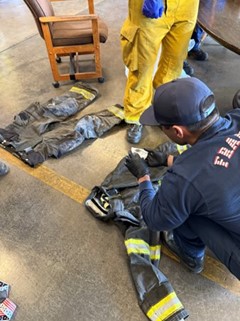
Sample collection on firefighter turnout gear using cleanroom wipes.
(San Jose Fire Fighters)
Additional occupational exposure early findings were shared by Co-principal investigators Ryan Tripp, fire captain with the Los Angeles County Fire Department, and Cristina Davis, professor of Mechanical Engineering at UC Davis. This team is studying live training exercises to identify activities associated with the highest chemical exposures. Researchers have developed sampling methods to track smoke levels throughout training days, with early data showing clear increases in smoke related and cancer linked compounds by the end of the training day in comparison to the start.
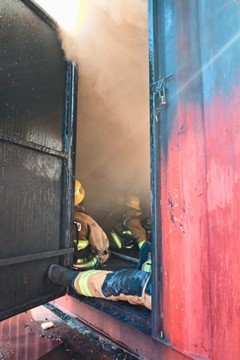
Firefighter trainers and recruits face heavy particulate matter,
volatile organic compound exposures during training exercises.
(Tripp/Davis)
Learn more about all of the funded projects and read summaries of their first year of progress in the funded grants database.
Knowledge Exchange Sessions
The meeting created a valuable space for research teams to learn from one another and troubleshoot common challenges across projects in consultation with fire service Advisory Committee members and program staff through small group discussions.
The program’s Advisory Committee is composed of six members from the State interagency firefighting advisory program, Firefighting Resources of California Organized for Potential Emergencies (FIRESCOPE), which had an active role in developing the program's priorities and technical assistance to help applicants build partnerships between UC academic and California-based firefighters. In addition to solutions for common challenges such as participant recruitment and retention, these discussions highlighted strong synergies and high enthusiasm for collaboration across the projects.
In the months to come, the program, in collaboration with the Advisory Committee, will work with projects to help raise awareness of this critical research, disseminate pilot award outcomes to the broader fire service community, and maintain engagement across the cohort as research activities progress and further findings become available.
The program plans to hold its second annual Advisory Committee and Grantee Meeting in November 2026.