
Safety and Loss Prevention
MAQ FAQs
Approved Storage
Do flammable liquid cabinets with a fusible link meet the self-closing requirement?
Certain highly toxic solids and liquids recommend storage at 4°C or in glove boxes.
Do either of these qualify as “approved” storage?
Exceptions
Is gas piped to equipment exempt from the Fire Code Hazardous Materials provisions?
Chemicals in Vehicles
Would a blood donor mobile bus need to be included in MAQ inventory?
Basement Storage
Are flammable and combustible liquids permitted to be stored in basements?
Compressed Gases
Do gases (gaseous) and liquefied gases have separate MAQs?
Are cryogenic fluids considered liquefied gases?
Are dissolved gases gaseous or liquefied?
Approved Storage
Does a California Fire Code (CFC) “approved” storage cabinet always need to be constructed of steel? Wouldn’t plastic (HDPE) cabinets be better for storage of corrosives?
Approved storage does not always need to be steel. The only exception is if it is wood meeting all the criteria under number 2, and this is only OK for flammable liquids.
Corrosives cabinets have to be made of double-walled steel to be Fire Code approved, and they should have a special coating that is corrosion-resistant. Plastic cabinets may be used for corrosives, but they would not qualify as "approved" storage nor impact MAQs. Given that corrosive MAQs are relatively high, plastic cabinets could be used (without applying the approved storage credit). The reason for the double-walled steel is that these cabinets are designed to keep the contents of the cabinet cool and safe in the event of a lab fire, giving building occupants time to safely evacuate.
Are older flammable liquid storage cabinets that are self-closing, meet the following criteria, yet lack a three-point latch be acceptable for storage of other classes of hazardous materials?
Cabinets that are self-closing and meet all of the criteria for a hazardous materials storage cabinet but lack a three-point latch can be used as approved storage for solid or liquid hazardous materials that are not flammable liquids. Old cabinets or cabinets that are not self-closing, self-latching or otherwise not approved for storage of other hazardous materials (such as corrosives) can be repurposed. These would not qualify for the "approved" storage credit, but this would still be better than no storage and could be sensible for chemicals with higher MAQs (such as corrosives) or for separating incompatibles (e.g., oxidizers separate from flammables). In other words, consider being strategic with limited "approved" storage cabinets. These can be prioritized for hazard categories where necessary to apply the storage credit to stay below MAQs.
Do flammable liquid cabinets with a fusible link meet the self-closing requirement?
Self-closing cabinets will close completely by themselves when you release the door. Fusible links could be present (usually designed to prop the door open) on self-closing or manual-closing models. Any model that is manually closing will not be considered approved storage.
Presence of a fusible link does not necessarily negate the self-closing mechanism, though it is not intended to be used to keep cabinets in the open position. Cabinets should only be held open with a fusible link while adding or removing containers, bar-coding/surveying events, or other temporary-use situations. If users normally prop the cabinet open with a fusible link, that would not be considered self-closing.
Are cabinets listed in accordance with UL1275 or compliant with NFPA 30 considered approved cabinets?
Not necessarily. UL 1275 and NFPA 30 (Flammable and combustible liquids code) allow for either manual or self-closing cabinets. In California (per CFC), self-closing cabinets are required. As long as the UL 1275 listed cabinet is a self-closing model, the cabinet would be considered approved storage.
Certain highly toxic solids and liquids recommend storage at 4°C or in glove boxes.
Do either of these qualify as “approved” storage?
If the highly toxics are in a listed flammable liquid or explosion proof refrigerator or freezer, that can be considered "approved” storage. Glove boxes can be used for storage of toxic and highly toxic materials, but they do not qualify for the “approved” storage credit since they are not designed to keep contents cool in the event of a fire. Storage of moisture and air sensitive chemicals within a dessicator placed inside a hazardous materials storage cabinet would be considered "approved” storage.
Can toxic gases be stored in a gas cabinet or exhausted enclosure with a face velocity of less than 200 feet per minute (fpm)?
Yes. While highly toxic gases are required to be stored in gas cabinets or exhausted enclosures with a minimum average face velocity of 200 fpm, toxic gases do not need to meet this stringent requirement. However, gas cabinets or exhausted enclosures with a velocity less than 200 fpm used for storage of toxic gases would not qualify for “approved” storage credits.
See also the following resources:
Approved Storage White Paper (how to apply Approved Storage credit)
Approved Storage by Hazard Class
Exceptions
Is gas piped to equipment exempt from the Fire Code Hazardous Materials provisions?
Gaseous fuels in piping systems and fixed appliances regulated by the Fuel Gas Code, Plumbing Code, or the Mechanical Code are exempt from the MAQ limits in the Fire Code. Refrigerant gases in the system are also exempt. Storage of refrigerant gases or compressed gases is not exempt from hazardous materials provisions. Storage of propane tanks, diesel fuel, or other hazardous materials used for generators or fueling equipment may be exempt when certain conditions are met.
Chemicals in Vehicles
Would a blood donor mobile bus need to be included in MAQ inventory?
Anything stored on a moving vehicle (as opposed to a trailer or container that is stationary) is not subject to the California Fire or Building Code requirements. If the bus unloads chemicals into a storage room at the end of the day, the storage room (or building) would be subject to MAQ requirements. Chemicals stored inside the bus that is regularly moving around are not subject to Fire Code MAQ requirements.
However, the mobile bus would fall under U.S. Department of Transportation (DOT) requirements for hazardous materials. Transportation of chemicals typically requires placarding of vehicles and training of individuals transporting or handling hazardous materials. See CFR 49 Parts 171-185.
The mobile bus does not need to be included in the chemical inventory.
Basement Storage
Are flammable and combustible liquids permitted to be stored in basements?
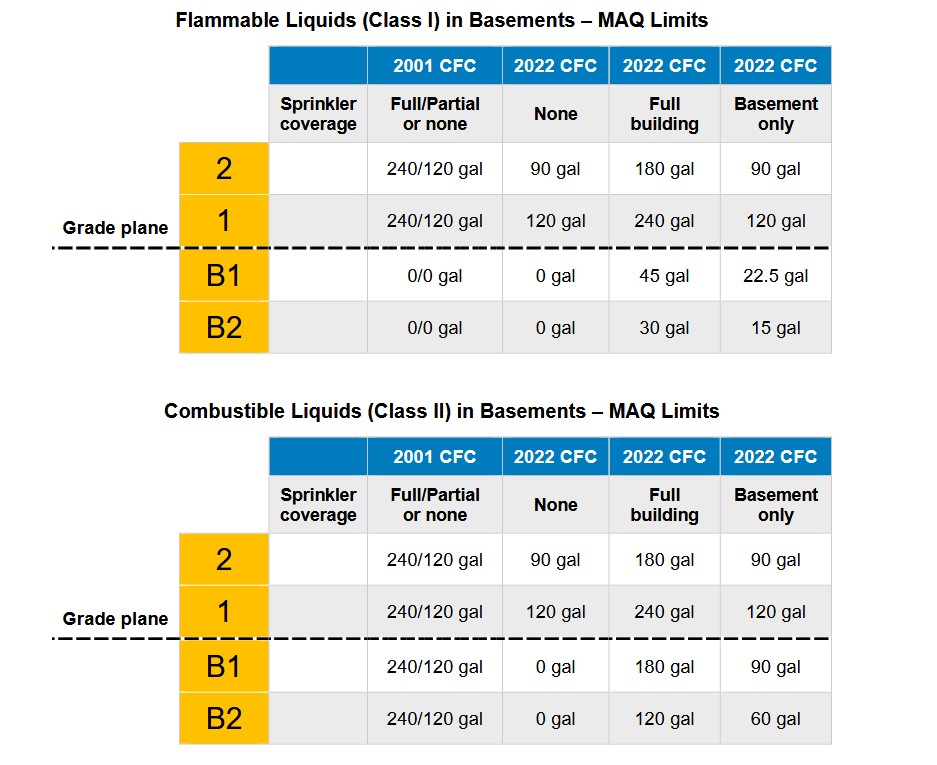
It depends. Prior to the 2007 CFC, flammable liquids were prohibited from being stored in basements (any story that is not above grade plane). Combustible liquids were allowed to be stored in basements prior to 2007. Current CFC prohibits flammable and combustible liquids from being stored in basements unless the basement has sprinkler coverage per Chapter 9 of the CFC. If basements have sprinkler coverage, flammable liquid MAQs for basements are limited to open use quantities.
Examples:
Compressed Gases
Do gases (gaseous) and liquefied gases have separate MAQs?
Yes. The amounts allowed per control area are separate for gases that are in the gaseous vs. liquefied state. For example, if you had multiple flammable gases in a control area, each would count towards the MAQ depending on the whether they were gaseous (G) vs. liquefied (LG). In this same example, a control area containing hydrogen (G), methane (G), propane (LG) and isobutane (LG) would have hydrogen and methane contributing towards the Flammable gas – gaseous MAQ while the propane and isobutane would contribute towards the Flammable gas – liquefied MAQ.
Common “gaseous” gases:
- Argon
- Carbon monoxide
- Ethylene
- Helium
- Hydrogen
- Methane
- Nitrogen
- Oxygen
- Nitric oxide
- Nitrogen dioxide
Common “liquefied” gases:
- Ammonia
- Butane
- Carbon dioxide
- Chlorine
- Ethane
- Hydrogen sulfide
- Isobutane
- Nitrous oxide
- Propane
- Propylene
- Sulfur dioxide
Consult the manufacturer’s product Safety Data Sheet (SDS) which should indicate whether a gas or gas mixture is a “compressed gas,” equivalent to Fire Code “Gas – gaseous,” or a “liquefied gas”, equivalent to Fire Code “Gas – liquefied.” Note that many of the above gases can also be in cryogenic form. Cryogenic fluids also should be considered separately from gases for MAQ purposes.
Common cryogenic fluids:
- Liquid Argon
- Carbon Dioxide, refrigerated*
- Liquid Helium
- Liquid Hydrogen
- Liquid Nitrogen
- Nitrous oxide, refrigerated*
- Liquid Oxygen
*Does not technically meet the Fire Code definition of a cryogenic fluid, although these can present similar hazards due to extremely cold temperatures.
Is the full volume of a flammable gas mixture considered for MAQ purposes or only the portion of the mixture that is flammable? What about when a gas cylinder is partially full?
If the mixture is considered flammable, the entire volume of the cylinder contributes to the MAQ limit. To determine if a gas mixture containing one or more flammable components is flammable, check the manufacturer’s SDS or reference Compressed Gas Association (CGA) P-23 (Standard for Categorizing Gas Mixtures containing Flammable and Nonflammable Components). Containers of gases (and other hazardous materials) are considered full for MAQ purposes, regardless of the quantity currently in the container.
Are gas mixtures containing toxic or highly toxic components classified as toxic or highly toxic gases?
It depends. Gas mixtures containing toxic components can be calculated based on the LC50 of the gas mixture, per CGA P-20 (Standard for Classification of Toxic Gas Mixtures). Manufacturer’s are required to classify the mixture as a whole for all relevant hazards. Check the product SDS, section 11 for Toxicological Information to determine the mixture’s LC50 to properly classify the mixture per Fire Code toxicity definitions.
Are cryogenic fluids considered liquefied gases?
No. While they are in a liquefied state, they are considered separately in the Fire Code due to unique hazards associated with extremely cold temperatures.
Are dissolved gases gaseous or liquefied?
Dissolved gases are typically considered gaseous for Fire Code MAQ purposes. A common example is acetylene gas, which is highly unstable in pure form. It is nearly always sold dissolved in acetone (or another stabilizer).