
Energy Services
Climate and Conservation: Energy Efficient Stoves for Small-Scale Palm Oil Production
The purpose of this initiative is to produce and support the distribution of improved energy efficient stoves for local palm oil production. These stoves replace traditional three-stone fires and use significantly less biomass. The pilot project focused on expanding the knowledge and capacity of project staff, local governments, and participating communities to implement and monitor carbon emission reductions from the use of these improved stoves. The initiative is a collaboration between the nonprofit project, Tuungane (Let’s Unite), the University of California, Climate Action Network-Tanzania, and local governments.
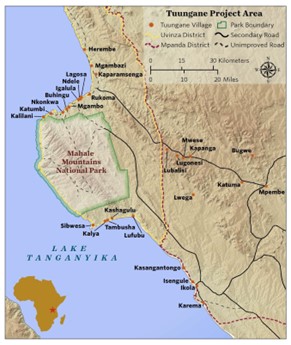
In 2010, several international partners (Pathfinder International, The Nature Conservancy, Frankfurt Zoological Society, and, later, the Jane Goodall Institute) teamed with local government and Tanzania National Parks (TANAPA) to address the interrelated threats to the well-being of both the people and the environment in the Greater Mahale Ecosystem (GME) in Western Tanzania, constituting the TUUNGANE project. The Mahale Mountain National Park (MMNP) is a critical habitat for several species including 90 percent of Tanzania’s endangered chimpanzee population and more than 300 species of fish. There are twenty-four villages within the GME with roughly 100,000 inhabitants. While road and cell phone communication are improving, the fast growing population is still largely cut off from the rest of the country and remains dependent on subsistence fishing, farming and herding for their livelihoods.
Small-scale Palm Oil Production
Palm oil production is a growing activity though at small scale, and with rudimentary hand-driven technology and traditional low-yielding varieties, although local extension agencies are beginning to distribute higher yielding varieties (see below). This carbon offset project (Climate and Conservation: Energy Efficient Stoves for Small-Scale Palm Oil Production in Western Tanzania) will build on the sustainable natural resource management, livelihoods, and health activities of the Tuungane project. The local NGO, Climate Action Network - Tanzania (part of CAN Global) will administer the scaled-up project, given its expertise in climate mitigation, including clean cooking stoves, and lower costs as compared with international agencies.
There are an estimated 30,000 palm oil farmers in Kigoma Region (3ADI+ 2019), and 2,600 palm oil farmers in Uvinza District (Ag Dept, Uvinza District 2019). Of the 2,600 farmers, an estimated 600 have processing sites of micro, small and medium capacities, many with multiple users (Ag Dept, Uvinza District 2019). Field work determined an aggregated potential demand for improved stoves at more than 1,000 in Uvinza District alone, where the project will be concentrated.
The planned growth of the small-scale palm oil industry in Western Tanzania raises both environmental and health concerns from the use of solid fuels for palm oil production. Small-scale processors burn both renewable (palm kernels, fronds) and non-renewable biomass fuels (hardwoods) using inefficient, three-stone fires to boil palm fruits to produce palm oil, which they later sell for a small profit (average of 0.5 USD per 1L) (Seed Change Tanzania 2016 and survey data 2021). This produces pollutants, such as black carbon, carbon monoxide, and particulate matter, that negatively impact climate and human health. This also burdens women who are primarily responsible for collecting the fuels. Improved energy efficient biomass cookstoves have the potential to reduce fuel usage and harmful emissions by 35-50% by improving the combustion and thermal efficiency through an advanced stove design and material, compared to three-stone fires. The improved stove design provides a metal fire chamber that both allows for cleaner combustion, as well as more efficiently directs heat towards the pot. Furthermore, government planned expansion of small-scale palm oil production contains plans to avoid biodiversity and food crop losses, approved by the National Agency of Environmental Management and reviewed by the Jane Goodall Institute and Tuungane staff.
Carbon Offsets and Co-Benefits
The first methodology used is Technologies and Practices to Displace Decentralized Thermal Energy Consumption, V3.1 August 2017 (TPDDTEC).1 The methodology is available online: https://globalgoals.goldstandard.org/407-ee-ics-technologies-and-practices-to-displace-decentrilized-thermal-energy-tpddtec-consumption/
The second methodology used is Quantification of climate related emission reductions of Black Carbon and Co-emitted Species due to the replacement of less efficient cookstoves with improved efficiency cookstoves, V1.1 August 2017.2 This methodology is available online: https://globalgoals.goldstandard.org/412-ics-slcp-black-carbon-and-co-emitted-species-due-to-the-replacement-of-less-efficient-cookstoves-with-improved-efficiency-cookstoves/
With this project, we will be able to deliver 7,770, 12,950 and 25,900 tCO2e emission reductions for 300, 500 and 1,000 stove options over the life of the stove, respectively. We focus on the mid-scale option, 500 stoves, as both most feasible and cost-effective. Considering total CO2e emissions reductions Including BC, CO, OC, and CH4 as the Non-CO2 Species, the 500 improved stoves will deliver a total of 83,170 tCO2e offsets over the five-year project period. Possible sources of under and over-crediting are detailed in the proposal cover letter.
In addition to the carbon offsets, this project has many co-benefits that will be of interest to the UCOP team, which are detailed in the PDD. These include the involvement of the local government in planning palm oil expansion among local farmers without incurring deforestation, loss of biodiversity or displacement of food crops, the strengthening of local employment and income generation among very poor families, and building community capacity to test, monitor and verify carbon reduction offsets from their activities, together with partners Climate Action Network-Tanzania and Tuungane.
|
Number of Stoves |
Estimation of Total CO2e Emissions Reductions Including only CH4 as the Non-CO2 Species |
Estimation of Total CO2e Emissions Reductions Including BC, CO, OC, and CH4 as the Non-CO2 Species |
Total Project Cost* |
Cost/tonCO2e (no BC) for 5y** |
Cost/ton CO2e (including BC) for 5y** |
|
1,000 stoves |
5,180 tCO2e/yr |
33,268 tCO2e/yr | $400,450 | $15.5/tCO2e |
$2.41/tCO2e |
|
500 stoves |
2,590 tCO2e/yr |
16,634 tCO2e/yr |
$266,490 |
$20.6/tCO2e |
$3.20/tCO2e |
|
300 stoves |
1,550 tCO2e/yr |
9,990 tCO2e/yr |
$176,200 |
$22.7/tCO2e |
$3.53/tCO2e |
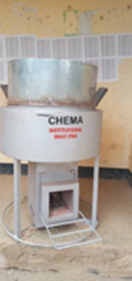
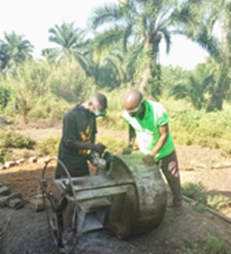
Figure 1: Improved stove Version 1, which uses hard wood only
Figure 2: Modification process which involved cutting and replacing the combustion chamber
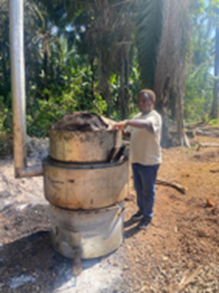
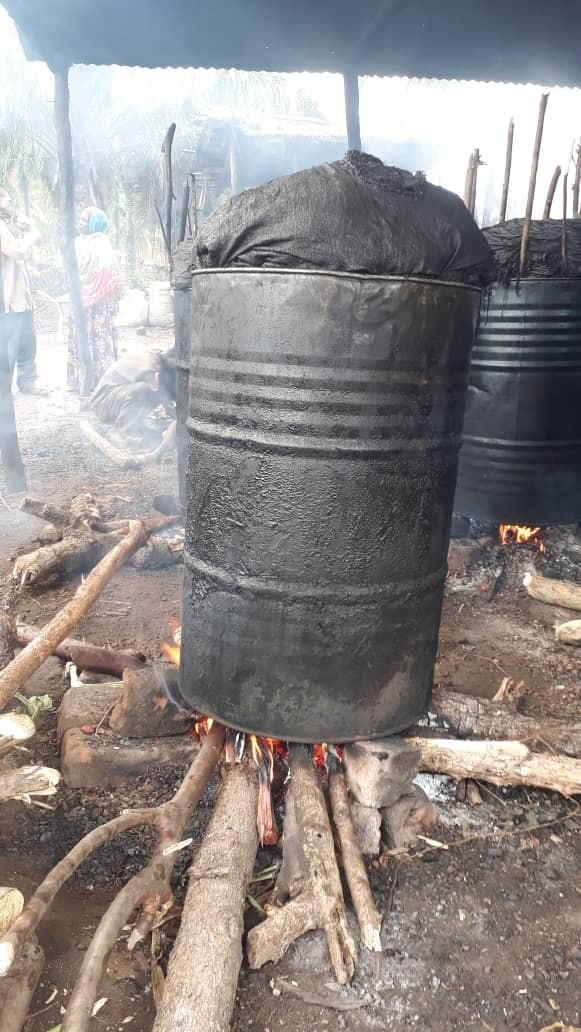
Figure 3: Improved stove Version 2 after modification
Figure 4: Traditional 3-Stone Stove
Project Lead/Key Members
 |
Ediphonce Joseph Lead on Energy Efficient Stoves Research |
 |
Robin Marsh Lead for UC Berkeley |
 |
Patrick Kinemo Pathfinder International, Tanzania |
 |
Samantha Hing Environmental Engineeing PhD Student UC Berkeley |
 |
Lucy Mlagala The Nature Conservancy, Tuungane |
Links
Tuungane (Let’s Unite), CHEMATanzania
⇐ Return to UC-Initiated Offsets page